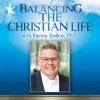
Exploring Bible Lands: An Interview with Barry Britnell
Barry is a friend who has become an expert and scholar on the Bible lands. In the last 15 years, Barry has also become a podcaster and on-camera host of a YouTube series that introduced the places in the Bible through Appian Media.
Barry has an amazing eye for detail. Let me know what you think about this episode, and be sure to reach out to Barry if you have questions about the holy lands at [email protected] or at Exploring Bible Lands.
Read the transcript
Kenny Embry: In this episode of
balancing the Christian life, we
talked a podcaster Barry
britnell about his travels in
Israel.
Welcome to balancing the
Christian life. We'll talk about
how to be better Christians and
better people in the digital
age. Let's go.
This week, I'm thrilled to
introduce you to a friend of
mine very brittle. Very was a
guy I worked with in the early
90s at a small private Christian
College in Florida. He is the
kind of guy who has an eye for
detail and thoroughness. Barry
majored in meteorology at
Florida State University. While
I studied communication, he has
a scientists brain and sees the
world in a way I simply don't
understand but appreciate as
long as I've known Barry, he's
had a passion for seeing things
in person, and then explaining
them in Episode 17. We talked to
Craig de height and Stuart Peck
from Appiah media. And Barry is
one of the guys in front of the
camera and three of their
projects, teaching us about the
geography related to the
biblical stories in person and
in this conversation. Barry
comes alive when he's talking
about how far below sea level
Israel is or how tall Mount
Hermon is. It's also a passion
you can hear if you listen to
his podcast, digging deeper,
which he co hosts with Ben
Kingsley for the first time in
20 episodes. I messed up big.
This is my second conversation
with Barry, although you will
never hear the first. Barry and
I had an hour long conversation
the week prior. And when I
listened to the playback, I
realized I used the wrong
microphone. I sounded like I was
in a deep barrel at the bottom
of the ocean during a typhoon.
It wasn't good. Barry was a good
sport and agreed to another
conversation. This conversation
lasted about 45 minutes, and I
edited it to about 25
Well, it's my real pleasure to
talk to an old friend of mine,
Barry Britton, Halle Berry,
Brittany, l. And I worked at the
same place a small little
College in Tampa, Florida, where
we were both student recruiters,
he and I became good friends
there. And I know his wife tab,
and his three children and just
an amazing family and somebody
who I've always liked always
admired and always thought a lot
of so Barry, welcome to the
program.
Barry Britnell: Oh, Kenny, it's
great to be here. I appreciate
the opportunity to to come on
board.
Kenny Embry: Tell me a little
bit about your Christian
background.
Barry Britnell: Like You I grew
up going to church and became a
Christian, when I was 12, or 13,
and always had a real interest
in the Bible and the Bible
stories. Of course, my parents
were very instrumental and
teaching me a lot of those
stories and teaching me about
Jesus. As I grew older, through
my teenage years and college
years, I learned that there's
just so much more to learn about
the Bible, there's so many
interesting things about the
Bible. And of course, what's
great about that is this is
something that you can learn
that's actually meaningful to
your life. And so that's kind of
the way I've lived my life is to
try to learn from these things,
and figure out how to apply them
to my life and those around me.
Kenny Embry: At some point,
Christianity has to stop being
your parents religion has to
become your own. Do you remember
when that happened for you?
Barry Britnell: It probably
happened when I moved away from
home. After I graduated from
high school, I left and moved to
Tampa, Florida to attend a small
Christian private school down
there. And even though I was in
the confines of a smaller
school, I was away from my
parents. And so I'm forced,
really for the first time to
make a lot of decisions without
them being right there next to
me, that's when you have to
stand up and realize, okay, I'm
on my own right now I have to do
this. This is not only something
I sort of believe this is
something I really believe.
Kenny Embry: Well, one of the
things that I remember when we
work together, you had talked a
lot about wanting to go over to
the Holy Land. At this point,
you've been several times, what
has it done for you as a
Christian?
Barry Britnell: Well, you're
right. Even when we work
together, I talked about it. And
at the time, you and I both had
friends who had travelled over
there since 2010. I've made
about a dozen trips over to the
land of Israel. But I'll tell
you, if I had to pick one thing
that I have learned in all my
travels is the biblical accuracy
of the Bible. And the way the
riders wrote is just striking.
Even the little details in the
Bible in which he talks about
David running up metabolics
barefooted when he was trying to
escape from the city. Well, that
was quite a climb. It gives you
a different perspective when you
actually see it with your own
eyes. And think about David
doing that. But I don't want to
come across as someone who says
that you must go to Israel in
order to understand, you know,
some geographical concept.
People learn in different ways.
And I don't think God wrote you
know, the inspired Word that
would be only understood by
people who traveled Israel. You
know, when we all get to heaven,
the percentage of people who
have been to Israel is going to
be incredibly small. And that's
because God's word is universal.
It's for anybody it can be
understood and obeyed by anyone.
But going over there for me, it
really did have an impact on my
life because I was able to
visually see these locations
that I'd studied my entire life.
And there are a number of things
that jumped out at you,
especially on your first trip
over there. For me, it was
understanding, first of all, how
small the country is. It really
is a tiny country, it's 40 to 50
miles wide is probably 150 miles
or so from Dan to bear Sheva.
It's incredibly geographically
diverse, you have to kind of
picture in your mind, an area
around where you live, think 25
miles east and west of your
current location and maybe 75
miles north of the south of your
location. And that's the area of
Israel. But the northern part of
that you have a mountain peak
that's over 9000 feet in
elevation. I mean, there's a ski
resort in the northern part of
Israel. That's something that
the news rarely covers is the
opening of ski season in Israel.
But yeah, there's a huge ski
resort on the top of Mount
Hermon. And then the southern
part of that year at the lowest
point on earth 1300 and 50 feet
below sea level at the Dead Sea.
And so the land is so
geographically diverse, but
understanding the differences in
the geography, when you overlay
that on the law, the stories
that you read in the Bible,
there are certain aspects of
those stories that just kind of
jump off the page that you never
realized before.
Kenny Embry: You and the guys
over at appian media have
basically brought us to the holy
lands with you. How did you get
involved with those guys?
Barry Britnell: I made my first
trip to Israel in 2010. And I
went back there on another tour
in 2012. Both of those tours was
with a gentleman by the name of
Pharaoh Jenkins, who has been
leading tours to Israel for 50
years. I decided in those trips
that I wanted to try to do this
as well. I've always loved
travel. I've always loved
organizing things. I love the
Bible. This was kind of the
natural merging of a number of
passions in my life. And so I
started leading these tours in
2015. I had a couple traveling
with me, Jeremy and Ana de
haute. And about a year later, I
got an email from Jeremy's
younger brother Craig. And Craig
and Stuart had been struggling
teaching Bible classes to high
school kids. And like it or not,
if you're under 20 years old,
you don't remember a world
without YouTube. That's the way
kids learn nowadays. Yeah. And
so what was happening is we were
taking kids into a Bible class,
what we were doing is taking
them into a classroom and
saying, Okay, put your phone
away, we're going to learn about
God now. Well, there is a valid
point to that argument there is.
But the other side of that is
why don't we use their phone to
help teach them about God. And
so they had the idea of
traveling to Israel creating
these videos. And so when Craig
asked his brother Jeremy about
it, because Jeremy had been on
one of my tours, Jeremy said,
Hey, why don't you talk to
Barry, he would be able to help
with the logistics of that. And
so Craig contacted me, we had a
wonderful first conversation,
Craig immediately told me the
idea that he and Stuart had, my
first reaction out of my mouth
was, however you want me to
help? I mean, when they first
contacted me, they were mostly
interested in getting logistical
help for the trip. You know, how
do you travel over there? Where
do you stay? Who do you need to
contact? What is there to see
what accessibility were they
going to have to different
places? And I was glad to help
with that. After a couple of
months of having another
conversation with them about
that. They had already kind of
decided that Jeremy would be the
on person spokesman. But they
asked me said, Hey, have you
ever been on camera? And I said,
No. But they said, We think we'd
like for you to kind of tag team
this with Jeremy. And so I said,
Well, I said I'll be happy to
give it a try. And and let me
just say these two guys are
great editors, Craig and Stuart
and jet because they make me
look a lot better than I really
am.
Kenny Embry: You guys used a
classic narrative technique,
which is have one person as the
expert and the other person is
the every man that asks a
question for the audience. And
Jeremy ended up being the every
man for us. And you ended up
being the expert. I realized
that Jeremy's a very bright guy
he probably knew answers to most
of the questions he asked, was
that intentional, was that the
formula that you guys
intentionally came up with?
Barry Britnell: Yes, to a
degree, all of those episodes
are completely unscripted. And
that's really the way we wanted
it. Jeremy and I would talk
about a specific scene. For
instance, if we're walking by
the Sea of Galilee, and we're
talking about Jesus calling his
disciples, we kind of had an
outline of what we wanted to
talk about. We said, well, let's
hit you know, kind of do these
two or three points. If we open
up the Bible, here's a passage
we can read. And that was really
kind of it. We wanted it to be
free flowing. As you accurately
stated, Jeremy is an incredible
student of the Bible. It's just
incredible. And so nearly all of
the questions he asked me were
questions that he asked already
knew the answer to. But you
know, the way we wanted to work
this was that maybe I would
introduce the place from a
geographical or cultural
standpoint, try to give some
relationships to, you know, one
geographical location to
another, or talk about the
history of the place. But then
Jeremy could then at the very
end, kind of wrap the whole
thing up and make an
inspirational point, some sort
of application that people can
use in their lives. For the most
part, we think that that formula
worked pretty well.
Kenny Embry: Basically, the way
Appian Media decided to deliver
these was via YouTube. This is
something that is a passion of
mine. It's called Digital
discipleship. I'm calling it
digital discipleship. And it's
that idea that here are a bunch
of tools that allows for really
easy delivery of content, when
you and I are kids. getting
something just distributed was a
hard thing to do. What have you
heard about the influence of
what you guys were able to do on
YouTube?
Barry Britnell: Well, I think
the word that you use, there is
a key word. And that's the word
tool. What we do, does not
replace God's word at all. In
fact, the purpose that we
created this was to help get
people interested into opening
up God's word. We love to hear
stories about people binge
watching, following the Messiah
or searching for a king. But
what really gets us excited is
when we hear of someone who
watches an episode, and then
opens up their Bible, because
it's in the Bible where real
truth is found. We'd like to
create these videos and the
workbooks and the other things
we do as tools to help people
become more engaged with God's
word. We constantly receive
emails, or phone calls or texts
from people who said, Hey, I was
watching this, I never
understood it that way. And
thank you so much. We're
bringing that out. When you use
tools like YouTube, or even our
website, you get analytics on
that our videos have been seen
across the globe, I forget the
actual numbers, but I know it's
over 100 and something
countries. And that's something
that myself, I never would have
been able to accomplish just me
working by myself without the
internet, because that allows us
to get that word out into
countries that I'll never visit.
Kenny Embry: I think you're
exactly right. It's a tool. And
every tool can be used, every
tool can be misused.
Barry Britnell: But that's
right. And even going back
farther than that, when you talk
about the origins of appian
media. And I believe that you
may have covered this with Craig
and Stuart, when you spoke to
them on on one of your episodes,
we came up with the name appian
media to be named after the
appian way, which was a road
that the Romans built in the
first century to be used for
their good. They used it for
commerce, and they used it for
to move their armies efficiently
across the land. But those roads
that they build, were also used
by the Christians to help spread
God's word. And we kind of see
the internet as today's appian
way. It's something that was
created. Is it misused and used
by bad people? Absolutely. I
mean, you and I both know,
there's some terrible, terrible
things on the internet. But
guess what? That same road can
also be used for good. And
that's what we're trying to do.
Kenny Embry: Yeah. And I think
you're doing a great job. You're
a podcaster. Now, explain to me
how that happened. And by the
way, I'm thrilled. I think
podcasting is a fabulous form.
And you guys have a great one.
My only criticism is this.
You'll need more of it. But But
other than that, you're doing a
great job. How did you guys
decide to get into podcasting?
Barry Britnell: Well, I
appreciate you saying that we
all of us had appian media,
there was a reason why we named
our company appian Media and not
at the end videos, we wanted to
be able to create all kinds of
media, from the very beginning
is just that video was the where
we went first. But even from
those very early beginnings, we
had the concept and the thoughts
of getting into podcasting. And
so that's what we have done. We
we actually have two podcasts
that are out right now Craig and
Stuart have a podcast called
inroads. It deals with using
different media and different
technologies now to help spread
God's word. And then Dan
Kingsley and I have a podcast
called digging deeper in which
we look at nuances in the Bible.
And a lot of times we just kind
of skim over those nuances. In
our podcast, we want to pardon
the phrase dig a little deeper,
and talk about maybe the
geography or the climate or the
culture of the lands of the
Bible so that we can help people
understand Bible stories even
more.
Kenny Embry: Yeah, I would even
go a step further. I think you
guys are really doing a nice job
of talking about the physical
sciences and how they play into
the biblical story. I love that
because that's not where my
brain goes. But I'm glad to see
that somebody is doing it
because you're shedding light on
things that I've never
considered before.
Barry Britnell: Right. You know,
my background. I got my degree
in meteorology, so I have a
weather background. And during
our first season, we actually
did an episode based solely on
weather in the Bible, and how
the weather works in Israel. For
all of us, the United States,
you know how the weather works
differently in the southern part
of the United States, then in
the northwest, and so that's the
same way in the land of Israel.
And once you understand how
weather works, you can
understand Bible stories a
little bit differently as well.
Dan is an oncologist, he has a
medical background. And so we
did an entire episode based on
medicine and the Bible and some
of the ancient methods that
people used to maintain their
health. And there's a number of
stories in the Bible that
related to that as well. And so
he talked about those from a
medical background. And as I
said, both of those concepts,
you know, it's not mandatory
that you become experts in the
weather or in medical
information, to understand the
principles that are being taught
in the Bible stories. However,
if you know those things, or at
least have a cursory knowledge
of that, there's just little
nuances to the text that just
kind of jumped out at you. Yeah,
I think one of the things you
guys did this with, with the
first couple of series, more
specifically, the second video
series, which was you guys talk
to archaeologists, an integral
part into what you guys are
saying is, there's not anything
in archaeology, there's not
anything with your podcast
series in biology or
meteorology, that refutes what
we read in the Scriptures, this
could absolutely happen. Right,
I'll openly admit, I am not an
expert in archaeology. In fact,
I can point you to a number of
other people who are, but I
enjoy studying it. I enjoy
visiting the sites over in
Israel where active digs are
taking place. And one of the
phrases I like to use is that
archaeology illuminates the
Bible, God's Word is true. I
don't need archaeology to go and
prove the Bible. But archaeology
does provide illumination for
the Bible. It helps us to
appreciate and better understand
a lot of the things that we
read. With that being said, the
more they dig, is, it's almost
humorous, but it's, it's
interesting to see how much the
biblical narrative is proven,
and reprove it over and over and
over again, the Bible will say
that a city was located here,
well, that can't find it. Well,
they go and dig there. And what
there it is, you know, there
have been people lately who have
said that maybe the United
Kingdom, especially David,
didn't exist the way that the
biblical narrative kind of
describes it. But guess what,
they've kind of gone out and
done some digs. And what we
found is that exactly what we
read in the Bible is what we
find in the ground, right? One
of the things that you and I
have talked about before is that
so much of the land out there
has not been dug up. And there's
a good reason for that. We are
very interested in the past. But
there are some people that are
interested in the present there,
they have a house, they've
gotten a mortgage, they've got a
job, they've got things that
they have to do on the land,
where historically important
things happened. That's right.
In fact, you don't have to go
very far to see that as you walk
through the city of Jerusalem,
there is a place in which you
can see, part of the wall that
was built around Jerusalem,
during the time of King has a
Kaia. It's a large portion of
the wall. But if you follow it,
you can only see like, maybe 100
feet of it. And the reason is,
is because that wall goes
directly into a building. Well,
that's because that building is
owned by somebody, you know that
the wall continues, but you just
can't get access to it. I mean,
imagine if someone came out to
your house that you own with
your family, and you live there
and said, We need to dig
underneath your house. You know,
your reaction beat? No, you're
not digging underneath my house.
And of course, that's the exact
same way they react as well,
right. I'll tell you another
story a couple years ago, they
found the pool of sologne that
we read about in john the night
chapter. And you can go and
visit it today. And it's very
interesting to visit and see and
kind of visualize that whole
story in your mind. However,
when you get there, only a one
side of the four sided pool can
be seen. The reason is, is
because the you know, 90% of the
pool is on private property.
Somebody owns that land. Yeah,
that's good and bad is bad in
the fact that we can't see the
whole pool. Now it's good in the
fact that we know where it is,
is protected. And hopefully
sometime in the future, that
maybe the conditions change a
little bit in which the the
Israel Antiquities Authority or
whoever's in control of that
area, can get access to it and
then dig it up, and then we'll
be able to see it. That's
exactly right. YouTube, and
podcasting is different. What
are some of the differences that
you've noticed? Well, you're
right, they're considerably
different. Now, what's
interesting about our podcast is
that the co founders of appian
media, Craig Dehut and Stuart
Peck are video producers by
trade, and so when we actually
recorded our podcasts, we
actually made video versions of
them as well. But you can
actually go to YouTube and quote
unquote, watch our podcast,
which is something a little
unique. You can also subscribe
to our podcast, we have all the
method that most podcasts can be
subscribed to. But there is a
fundamental difference in those
two mediums. I think there's a
place for both of these mediums.
I completely agree. And this is
the communication professor in
me, I think podcasting is a is a
more intimate medium,
specifically, because I get to
take your voice in my earbuds to
the grocery store, and wherever
else am I going. But in order to
watch your video, I'm going to
have to reserve a part of my day
to do that. What specifically do
you think are the differences,
you hit on it right there, I
think with podcasts, you can be
much more personal. For
instance, when you watch a
video, most of the time, you're
not watching a video by yourself
with a podcast, most of the
time, you're listening by
yourself, whether it's, as you
said, walking through the
grocery store, or as you're
walking around the neighborhood
doing exercise, or as you're
driving in your car, you're
probably by yourself. And at
least for me, when I watch a
video, I'm thinking, what can I
learn from this? But when I'm
listening to a podcast? Of
course, it depends on the type
of podcast, some podcasts are
purely entertainment, which is
perfectly fine. But then a lot
of podcasts, I'm thinking to
myself, how can what I'm hearing
make a difference to me right
now? Yeah. And you can make a
more personal application for
that. As I said, I think there's
room for both mediums in
spreading the gospel. And I'm
glad to hear that being media
that we're able to do those. And
I'm glad to see other people
doing those as well.
Kenny Embry: Yeah, me too.
There's an art to podcasting
that all of us are trying to
master, which is treating a
podcast as a conversation with
the understanding that the other
person is talking back. They're
listening, but you kind of have
to start anticipating what
questions that they have. Again,
I'm a cheerleader for the
format. I think it's something
that I'm a big fan of. And I
think it does allow you to
engage in, I guess, those spare
cycles of the brain where you
are driving, but that doesn't
take all your concentration. And
here's something that can help
you with that. Do you agree with
that? Well, I
Barry Britnell: do. And in fact,
as you were talking, I was
listening to everything you were
saying. And you finally hit the
word that I was thinking of. And
that was engagement. That's the
key to any sort of successful
medium, is you want to do things
to engage your audience. And so
for instance, with a podcast as
you go back and forth, if you're
interviewing someone, you do,
just like what you said, You
need to be able to think, how
are the listeners listening to
this? And what questions are
they asking in their own minds
based on what I'm hearing right
now, if you're doing a podcast
by yourself, then you almost get
more into the storytelling, you
need to be very descriptive in
what you're saying, and pull the
people in so that they can
listen, and they're engaged by
what they're hearing. The same
holds true for video. But with
video, you actually you're able
to tap into another sense. And
that's the sense of sight. You
can use video and pictures and
things like that. But even with
video, you want to find ways of
engaging people and getting them
involved in what you're saying
or doing.
Kenny Embry: What kind of
reaction Have you had to your
podcast,
Barry Britnell: we've had a very
positive day. And I've really
enjoyed doing it. These are
topics that Dan and I are really
passionate about. What we've
done is basically take our
dinners, our discussions, and
we've just recorded them.
Because what you hear on our
podcast is exactly what you
would hear if Dan and I were
sitting across the table from
each other at a local barbecue
restaurant. We love talking
about whether in the Bible or
medical issues and the Bible, or
just different stories in the
Bible, and how they relate to
geography. And so what what
we've done with the podcast is
just remove the barbecue
restaurant away from it, and
stuck microphones in front of
our faces, and just recorded it.
And I think that appeals to a
lot of people because they love
hearing us just talk about these
topics because it's not
necessarily about a specific
Bible story. It's about an
aspect of the story. Right?
People have really enjoyed
listening to it. Well, good. I
enjoyed listening to it. What
have I not asked what what do I
need to know? I love God's word.
And I love teaching people about
God's word. One of the things
that COVID has done is it's
restricted in some ways our
ability to travel and to talk to
people. These mediums like this,
like the podcast have helped
fill those gaps. But I do miss
going into a congregation to
spending a couple of days with
him talking about biblical
geography, and I long for the
days in which we're able to do
that again. But in the Meantime,
I enjoy having conversations
like this through podcast or
just someone even just picking
up the phone and calling me and
saying, hey, got a question
about, you know, the Sea of
Galilee
Kenny Embry: I in my podcast, be
good and do good. What's good?
Unknown: Well, that's a good,
that's a good question.
Barry Britnell: Well, I tell you
what, let me use that word to
define the word. Whenever I
think about the word good. My
mind immediately goes to Luke
the 10 chapter with the story of
the Good Samaritan. He wasn't
just a Samaritan, he was a good
Samaritan. And, you know, we all
know that story of gentleman's
walking from Jerusalem down to
Jericho, and he falls among
thieves, and he's left there to
die. And then two people pass
him that, by all means, should
have stopped. And having been to
the area personally, myself, I
don't, it's almost
unconscionable why you wouldn't
stop because there is nothing
around. I mean, you're not even
risking a reputation tarnishing
because no one would even see us
stopping. But the priest in the
laidback go on but then this
Samaritan comes by a man that
you would think, would not stop
for maybe political reasons. But
he does. He was looking for
opportunities to do good to do
something for someone else. He
was thinking of others first.
This was a person wanting to go
the extra mile to help someone.
And to me, that's what good is,
Kenny Embry: if somebody wanted
to get a hold of you, how could
they do that?
Barry Britnell: Well, they can
reach me through appian media,
Barry Britton with epi
media.org. Or they can reach me
through my website exploring
Bible and calm. That's the
website that I used to advertise
the tours that I lead. I
actually have two tours going
over to Israel in 2021. And one
tour to Turkey and Greece.
Really looking forward to to
going on these tours and
traveling again.
Kenny Embry: Well, thanks very
much, man. I really appreciate
this.
Barry Britnell: Yeah, I've
enjoyed it, too. Thanks, Kenny.
Kenny Embry: I hope you enjoyed
my conversation with Barry. He
has a sharp analytical brain.
And I think his perspective on
traveling in Israel gives a
deeper understanding of the
biblical narrative. Also, be
sure to listen to his podcast
digging deeper. Barry, you're
doing good work, my friend.
Thanks for all you do. Next
week, I'll be talking to another
podcast host Jason Romano. He
had a long career with ESPN as
producer and counts Darryl
strawberry among his good
friends. He also has an amazing
story about how he came to
Christianity. After a difficult
and tumultuous relationship with
his dad. It's a conversation you
need to hear. I've also been
working on my website, balancing
the Christian life calm. I'm
putting more related information
about where I hope to take the
podcast in the future, as well
as a book I'm putting together
based on the first 10 episodes
of the podcast, sign up for the
email list if you're interested
in hearing about that. So until
next week, let's be good and do
good.

 Rss
 Breaker
 Player.fm
 Radio Public
 Apple Podcasts
 Castbox
 Castro
 Overcast
 Pocket Casts
 Google Podcasts
 Spotify
 Stitcher
 TuneIn
 iHeartRADIO